You’ve read five articles about nearshoring to Mexico this month, and you still couldn’t explain what IMMEX actually means if your CFO asked you directly in the budget meeting. That’s not a knowledge gap you created. Most nearshoring content is written by consultants and marketplaces, not by the manufacturers who live inside these rules every day.
This guide is different. It comes from an IMMEX-certified electronics manufacturing services (EMS) operator, not a summary of someone else’s summary.
What IMMEX Actually Is
IMMEX (Industria Manufacturera, Maquiladora y de Servicios de Exportación) is Mexico’s program that allows manufacturers to temporarily import materials and components without paying the standard import duties, as long as the finished product is exported. SILBIT operates under IMMEX Registration 261-2022, which is what allows internationally sourced components to move through Mexican manufacturing without the cost layer that would otherwise apply.
What PROSEC Adds
PROSEC (Programas de Promoción Sectorial) works alongside IMMEX to further reduce duties on specific categories of components used in electronics manufacturing, when the finished product qualifies under the program’s sector rules.
What USMCA Changes for Electronics
The United States-Mexico-Canada Agreement (USMCA) sets the rules of origin that determine whether a product assembled in Mexico qualifies for preferential tariff treatment moving into the United States and Canada. Whether a specific product qualifies depends on where its components originate and how much value is added during manufacturing in Mexico, which is why this is a conversation to have directly with your manufacturing partner, not a blanket assumption.*
How Long Does IMMEX Approval Take
For a company already sourcing from an established IMMEX-certified operator, this isn’t a question you need to answer yourself. The certification already exists at the plant level, so the timeline that matters to you is your own production ramp, not a new registration process.
What This Means for Landed Cost and Lead Time
Beyond the compliance layer, manufacturing in Mexico under IMMEX and USMCA typically means:
- Ground transit of 3 to 5 days to the U.S. and Canada, instead of weeks by ocean freight.
- Shared or overlapping time zones with U.S. and Canadian teams, so engineering questions get answered same day.
- USMCA-aligned trade treatment,* reducing the cost layer that comes with sourcing from outside North America.
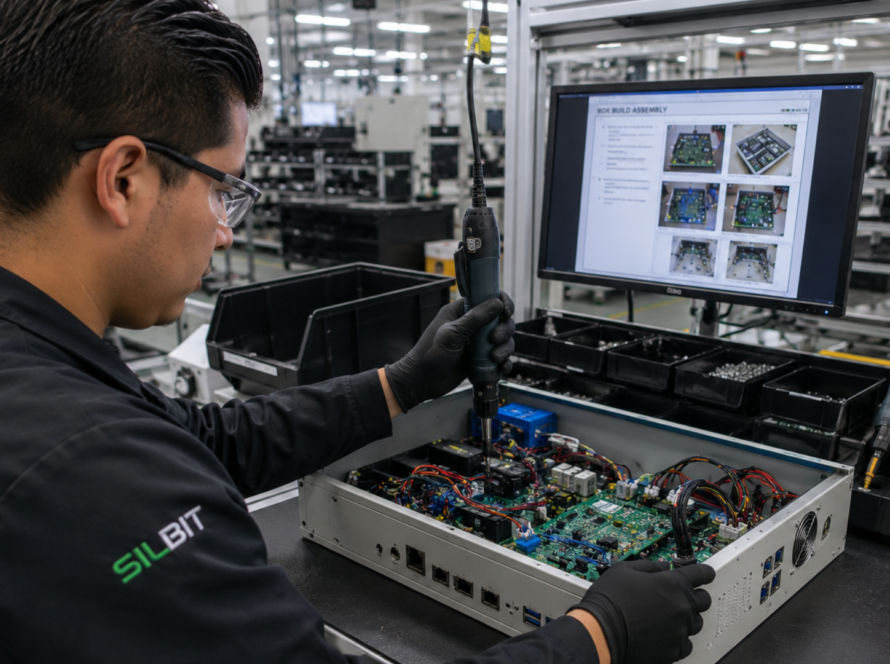
Same day answers matter most during system integration, where mechanical, electrical and firmware decisions overlap in the same build. That stage is covered separately in what box build assembly includes.
Why This Matters Coming From an Actual Operator
Reading about IMMEX from a manufacturer that holds the certification is different from reading about it from a directory or a consulting firm that doesn’t manufacture anything itself. SILBIT has operated as a certified IMMEX operator (Reg. 261-2022) with PROSEC certification for 12+ years, exporting nearly 80% of production to the United States, with the remainder to Canada.
If you’re evaluating nearshoring and want a straight answer about how IMMEX, PROSEC, and USMCA apply to your specific product, not a generic overview, talk to our engineering team for a free manufacturing assessment. Walk into your next budget meeting with a plan, not just a slide from someone else’s webinar.
*Trade treatment and duty advantages depend on product classification and rules of origin; confirm specifics for your product with SILBIT’s team.